Anna Wintour's Head Says No: What Five Minutes of Body Language Reveals About the Real Power Structure at Vogue
Five nonverbal moments from the New York Times interview that reveal what Anna Wintour actually thinks about her successor and what it means for anyone navigating power, perception, and female leadership.
February 25, 2026
By Tatiana Teppoeva, PhD
Nonverbal Intelligence & Executive Presence Expert
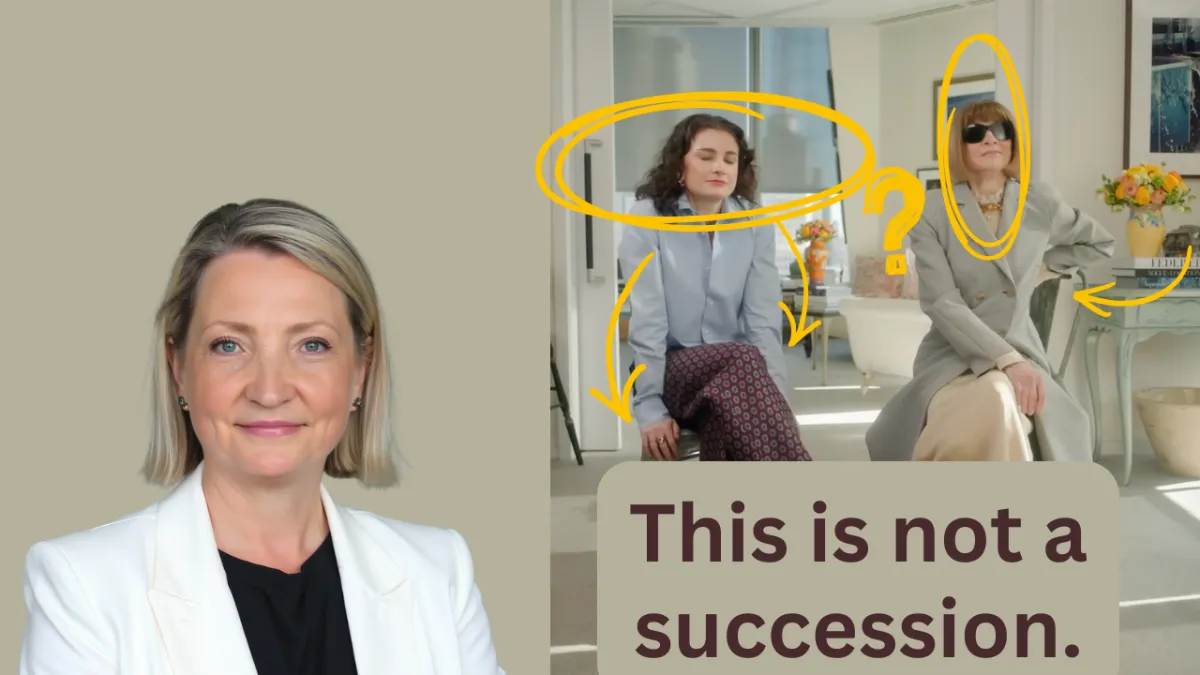
Anna Wintour and Chloe Malle in their joint New York Times interview.
Five minutes of footage that reveals more than the words.
This Is Not a Succession
When Anna Wintour and Chloe Malle sat down together for their joint New York Times interview, most people read it as a leadership transition. A graceful passing of the baton. A new era beginning. I read it as a nonverbal intelligence expert. And what I found was something different entirely.
Anna Wintour did not step down. She moved up. She is now Global Chief Content Officer of Condé Nast and Global Editorial Director of all Vogue editions worldwide. Chloe Malle became Head of Editorial Content for American Vogue — a role that sounds like Editor-in-Chief but operates within Anna's global framework. The old role had sovereign authority. This new role has operational responsibility.
What you are reading about in this interview is not a boss handing over the keys. It is a boss introducing the person who now runs the day-to-day while the boss remains upstairs. This distinction matters. Because it changes everything about how we read what their bodies are doing.
Who These Two Women Are
To understand the signals in this interview, we need to understand the personalities behind them. Because personality shapes every signal the body sends.
Anna Wintour. British-American, 76 years old. Born into a media family where her father Charles Wintour was the longtime editor of the Evening Standard in London. She grew up where institutional authority was dinner table conversation. She has been Editor-in-Chief of American Vogue since 1988. Thirty-seven years. She transformed it from a fashion magazine into a cultural power platform and built the Met Gala into the global event it is today.
She chose her signature bob haircut at fifteen and has not changed it since. She introduced the Chanel sunglasses around forty and she has explained them herself as armor. A way to manage what people can read from her face. Notice that. A woman who has spent 37 years deciding whose careers advance and whose do not, she understands the power of perception and manages her own deliberately.
Chloe Malle. American, 40 years old. Daughter of actress Candice Bergen, granddaughter of legendary ventriloquist and radio performer Edgar Bergen. She grew up surrounded by media and public life but from the entertainment side, not the editorial institutional side. She has worked at Vogue for about fifteen years. Since she took over the digital operation in 2023, direct traffic to Vogue.com doubled. Fourteen and a half million unique visitors per month. These are real, measurable results.
And yet the public reaction to her appointment has been largely negative. People call her boring. Low charisma. Not enough presence. She receives criticism despite delivering strong performance numbers. That gap between results and perception is central to everything I want to share with you here.
From a personality profiling perspective, Anna reads as what I call a Strategist-Executor type. People with this personality type usually has long-term vision, institutional discipline, low emotional volatility, high control. She moves toward her goals and removes obstacles. She does not explain herself. She does not need your approval.
Chloe reads as a Connector-Initiator. This personality type is relationship-oriented, collaborative energy, people-first thinking, high warmth. She wants to include, to modernize, to expand.
These are not opposing types. But they are very different energy directions. And when succession happens between these two structures, even a partial succession, that difference in energy will create friction. Friction that shows up in the body.
The Archetype Before the Film
Before examining the interview itself, I want to say something that reframes how most people see Anna Wintour.
Many people think of Miranda Priestly when they read about Anna — the controlled silences, the declarative statements, the authority that does not ask for permission. It feels cinematic because we have seen it on screen.
But that comparison is backwards.
The Devil Wears Prada did not create this archetype. It documented it. Lauren Weisberger worked as Anna Wintour's personal assistant at Vogue and wrote the novel as a roman à clef, a story based directly on real events. Miranda Priestly was drawn from Anna Wintour. The 2006 film was drawn from the novel. The signals we are about to analyze, the permission dynamic, the head shake, the power reassertion, are not fiction. They predate the novel by years and the screenplay by decades.
Anna Wintour is the original. The book and the film are the portrait.
Understanding this matters because it tells us these are not performed behaviors. They are deeply embedded patterns that operate below conscious awareness. Which is exactly what makes them so revealing.
Moment One: The Opening Image
Before a single word is spoken, the opening image tells us something important.
Anna is wearing a coat and boots as if she stepped in from outside and is not planning to stay long. Chloe is in a shirt and pants, comfortable. Anna's posture is contracted: right leg bent under the chair, arms crossed in front of her body. She is oriented toward Chloe, but everything from the neck down says she would prefer not to be in this conversation.
In other interviews, Anna typically occupies space with more authority and ease. Here she is contracted. The body is telling us something the words will not.
If we now look at Chloe, we will see that she is sitting straight, legs crossed but her top foot is pointing away from Anna. Not toward her. In body language, we call this foot orientation. We unconsciously point our feet toward what we want to approach and away from what makes us uncomfortable.
Neither of them looks entirely comfortable. The whole scene reads like two people who may have just had a disagreement before the cameras turned on and now have to perform collegiality for the New York Times.
Maybe that is exactly what happened. Maybe not. But this is what the body is communicating before anyone speaks.
Moment Two: "Where Is the You?"
One of the most interesting moments in the interview is when Chloe quotes Anna saying to her: "Where is the you? Where are the weird dogs?"
On the surface, this sounds like encouragement. Like a mentor telling her successor: bring yourself into this. Be personal. Be you.
But we can notice what Anna does with her hands while Chloe describes this exchange. Her left arm is supporting her body. Her right arm is still crossed in front of her. Her fingers on the left hand are moving in small, controlled movements. Processing something. Her head is down. This does not look like excitement or warmth in this moment.
Here is what I want you to understand.
"Where is the you?" is permission. But permission is also hierarchy. Only the person with authority can give permission.
The words sound warm. The structure underneath them is: I decide what is acceptable here. I am inviting you in, which means I could also not invite you in.
Anna is not being cruel. She is just being Anna. But her body knows exactly what the power dynamic is, even when she is being generous with it.
Moment Three: "Strong Personality"
This moment is short. Easy to miss. But important.
Anna says: "Every great editor is going to have a strong personality."
The moment those words land, we can notice Chloe's reaction. She looks away. Not casually. With what I would describe as concern, or discomfort, or the instinct to find support somewhere else in the room.
Why does "strong personality" land that way?
Because it probably did not start as a general statement. Based on what their bodies are telling us throughout this interview, I think it is likely that this phrase has been used between them before. In a private conversation Chloe was not fully comfortable with.
Strong personality as encouragement sounds like: be yourself, be bold.
Strong personality as pressure sounds like: you need to be more than you currently are.
We cannot know which it was. But Chloe's body tells us she has heard it before and it has not always felt like a compliment.
Moment Four: "But to Be Clear"
This is the moment most people noticed and the one I find most revealing about how power actually operates in this relationship.
Chloe is talking about what she would do with budget if she could allocate it differently. She sounds open, idealistic, operational. She is sharing her genuine vision.
And then Anna interrupts with four words.
"But to be clear."
Those four words do not dispute what Chloe said. They do not correct a fact. They redirect the frame. They say: let me remind everyone in this room, and everyone watching, that I am still the authority on how this institution operates.
Notice how Anna's energy shifts in this moment. Her body becomes more present, more directed. The contracted quality we saw at the beginning moves into something more active.
This is a power reassertion. Not aggressive as Anna is far too sophisticated for that. But unmistakable.
And here is what I want you to notice about yourself when you are on the receiving end of this in a meeting or a conversation. Most of us shrink. We qualify what we said. We soften it. We look for approval. Notice what Chloe does next and consider whether you recognize that pattern in yourself.
Moment Five: The Head Says No While the Mouth Says Yes
This is the most important signal in the entire interview.
Anna is speaking about Chloe, and she says something genuinely warm: "Chloe is already a great Vogue editor."
Notice Chloe's face when she reads or hears this. There is real appreciation there. Public recognition from Anna Wintour matters. It has always mattered.
We notice Anna herself. While her mouth is saying Chloe is already a great Vogue editor when her head is moving from side to side. Slightly. Subtly. But it is there.
This is one of the most important signals in nonverbal communication. When the head shakes "no" while the words say "yes", the head is telling you what the person actually believes.
Anna is not lying. She may genuinely want to believe it. She may even partially believe it. But her nervous system, the part that operates below conscious editing, is giving us a different answer. She does not yet fully believe that Chloe is already there.
And if Anna does not fully believe it, that gap will shape every interaction between them. Every note, every decision, every room where Anna's opinion matters.
Chloe's challenge is not her results. Her results are measurable and strong. Chloe's challenge is the perception gap that exists in the one room where it matters most.
The Pattern: What All Five Moments Add Up To
The whole interview reads like a conversation between a daughter and her very strict, very opinionated mother who is difficult to please. A daughter who is working hard to prove herself and who wants, more than anything, to remain who she is while doing it.
There is one frame in the interview where they are both oriented toward each other. They are also both completely closed. Arms crossed. Mirroring each other's armor. This is what guarded mutual respect looks like in a body. Not warmth. Not distance. Something more complicated than either.
Two women. Two completely different leadership architectures.
Anna speaks in declarative statements. Institutional tone. She does not explain herself. She certifies.
Chloe speaks with context, warmth, and openness. She humanizes.
One defines leadership through distance and authority. The other defines it through relationship and availability. Chloe humanizes. Anna legitimizes. Chloe explains. Anna certifies.
Neither of these is wrong. They are different ways female power can express itself. And here is what is interesting and a little unfair: Anna is criticized for too much dominance. Too closed. Too cold. Chloe is criticized for not enough dominance. Too open. Too warm.
Two women. Opposite criticism. The same underlying message: whatever you are doing, it is not quite right.
This is the double bind of female leadership. And it does not live in the words people use to describe these women. It lives in the signals we respond to before we have language for it.
This was not a passing of the baton. It was a redistribution of power. And their bodies knew it even when their words did not say it.
What This Means for You
If you have ever been in a meeting where your voice changed when you mentioned your boss's name that is the pattern visible in Chloe throughout this interview. Her vocal quality shifts specifically in moments where Anna's judgment is present. It is not random. It is the nervous system responding to perceived evaluation.
If you have ever explained yourself more than necessary when someone with authority is in the room that is the Connector type operating under Strategist pressure. The body tries to bridge a gap through words when it cannot close it through structure.
If you have ever received praise and then noticed the person's head move slightly in the other direction, now you know what to look for. The praise and the reservation can exist at the same time. People are complicated. Authority is complicated. Neither cancels the other out.
The question worth sitting with is this: in the rooms that matter most to you, do you know what signals you are sending before you speak? Do you know which ones are working for you and which ones are working against you?
Because results on paper, like Chloe's traffic numbers, do not always speak for themselves. Perception speaks first. And perception is built from signals most people never examine.
Watch the full video breakdown on YouTube.
I work with leaders and organizations to make nonverbal authority signals visible in high-stakes professional decisions.
If you want deeper insight into nonverbal intelligence and executive presence in AI-augmented evaluation environments, you can join my newsletter below or downloading my free guide on decoding nonverbal signals at tatianateppoeva.com/decode.
Media & Speaking Inquiries
For interviews, commentary, podcasts, and speaking engagements:
Email: [email protected]
LinkedIn: https://www.linkedin.com/in/tatianateppoeva