McDonald's CEO Body Language: When Marketing Meets Reality
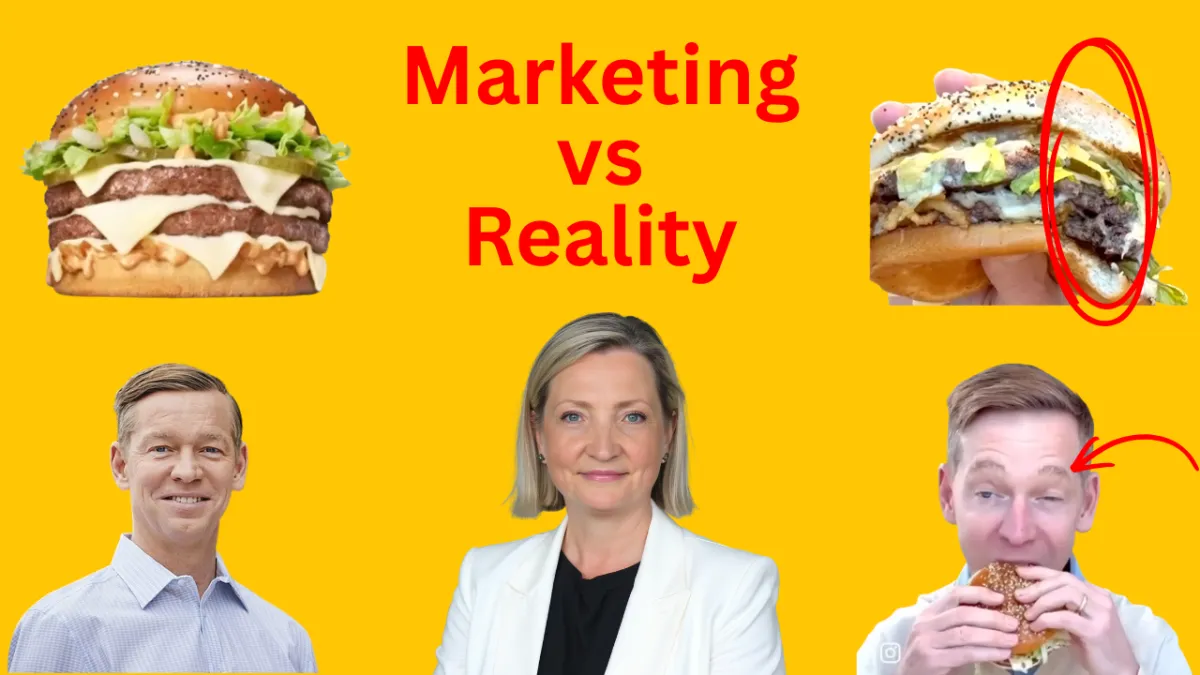
The McDonald's CEO went viral eating a Big Arch burger. Millions felt something was off.
March 20, 2026
By Tatiana Teppoeva, PhD
Nonverbal Intelligence & Executive Presence Expert
When the body and the brand tell different stories, the body always wins.
The Moment That Started Everything
In February 2026, McDonald's CEO Chris Kempczinski posted a short Instagram video introducing the Big Arch burger. The video was simple with a CEO, a burger, and a casual tasting. Within days it had generated 10 million views, competitor campaigns from Wendy's, Burger King, and A&W, and global news coverage. Most of the commentary focused on whether it was a marketing mistake or a calculated controversy.
Both groups were reacting to the same thing. A gap they could feel but not explain.
That gap is what this article is about.
Who Is Chris Kempczinski
Before analyzing any signal, we need to understand the baseline. Because the gap between who Kempczinski is and what the brand needs him to be is the entire story.
Kempczinski is 57 years old, a Duke University graduate with a Harvard MBA. His career moved from brand management at Procter & Gamble, to corporate strategy at PepsiCo, to international operations at Kraft Foods, to global strategy at McDonald's, where he became CEO in 2019 and Chairman in 2024. His annual compensation is approximately 19 million dollars. In college, his nickname was The Colonel, it is after Duke's legendary basketball coach, and not for warmth or charisma, but for discipline, structure, and strategic control.
His former boss at Kraft Foods described him as a business savant who translates insight into action into results. He came into the CEO role after his predecessor was dismissed for violating company values. His entire entry was built around values restoration, ethics, and organizational credibility, not brand energy, not performance theater.
In personality profiling terms, this is the Executor-Analyst type. The Executor is the dominant pattern — order-driven, structured, deeply focused on how things work rather than how they look. The Analyst runs underneath prioritizes processing, modeling, and optimizing before acting. His career arc is not a straightforward operator's path. It is someone who spent decades studying how systems work before running them. Together, this combination produces a leader who is excellent at running complexity and genuinely uncomfortable performing enthusiasm he does not actually feel.
He is also a marathon runner who has completed over 20 marathons and runs more than 50 miles a week. He does eat McDonald's. For example, Egg McMuffin no bacon, fries almost every single day by his own account. He is not hiding from the product.
But his body and this brand are telling two different stories. And the video made that visible to everyone.
What the Words Were Doing
The first signal worth examining is not physical. It is verbal.
Kempczinski opens the video with: "I love this product." When people talk about food they actually enjoy, they say this burger, this meal, this sandwich. Product is the language of a supply chain meeting, not a lunch table. It is how you refer to something you are responsible for selling, not something you are excited to eat. The word choice is a small thing. But small things are exactly where the truth lives.
Later he describes the burger as having "a very unique kind of sesame poppy sort of bun" and "sort of cheeses." In communication analysis, words like kind of and sort of are called hedges. They appear when someone is thinking while speaking instead of delivering a message they have rehearsed and internalized. I listened to his other interviews, this is not how he normally speaks. He is precise, structured, and analytical. The hedging is specific to this task. It tells us something about his relationship to what he is being asked to do.
He also says: "I don't even know how to attack it." Most people do not attack their lunch. This is the language of someone improvising in real time, searching for words, filling silence. When the brain is performing and processing simultaneously, when the body and the message are not aligned, the word choices drift toward whatever the nervous system finds first.
What the Body Was Doing
He opens with: "This is something we tested already" and at exactly that moment, his hand forms a blocking gesture. In nonverbal communication, when preemptive justification and a blocking gesture appear together, it signals one thing: the speaker is already anticipating criticism and trying to close it before it arrives. The CEO of McDonald's was defending a burger before a single person had said a word against it.
Then he says: "That's a big bite for a Big Arch." And takes what analysts estimated was 2.3 percent of the burger. The name promises big. The ad promises big. The CEO promises big. None of them delivered big. This is not just funny, it is the entire thesis of the video compressed into four seconds.
To understand why this particular video registers so differently from his other appearances, compare it to the Ghost Pepper McChicken clip from the McDonald's Worldwide Convention in Barcelona in September 2024. Same person, same camera format, same general setup. In Barcelona he is more expressive, more animated, the face and the words are running on the same track. In the Big Arch video, the performance and the body have separated. This is what I call Signal Drift when signals shift under pressure. The person is not lying. But something about this particular task has created a gap between what they are presenting and what their nervous system is actually communicating. And this was not one video.
The McRib, the McPlant, the Chicken Big Mac, the Big Arch, i.e. at least six documented instances of the same pattern. One awkward video is a bad day. Six videos is a signal.
In a separate video from July 2024, Kempczinski answers a question about why someone should build their career at McDonald's. He gives a professional answer, then says: "But it's a fun brand and..." Watch his head at that exact moment. It moves from right to left. Slightly. But it is there. When the head shakes no while the mouth says yes, the head is telling you what the person actually believes. The Executor-Analyst does not think in terms of fun. He thinks in terms of systems, results, and long-term value creation. And the body confirms it every time.
The Contradiction at the Center
His body does not belong to McDonald's. It belongs to a different person than the one the brand needs him to be.
Operationally, Kempczinski is excellent. Global systemwide sales grew 7 percent to over 139 billion dollars in 2025. The business is performing. But operational excellence and brand embodiment require completely different signal profiles. Some leaders embody their brand naturally because the brand is an extension of who they already are. Kempczinski is not that kind of leader for this kind of brand. And the body shows it every time he picks up a burger.
The public reaction confirmed this. The response did not split the way a typical bad ad does: half laughing, half moving on. But two things happened simultaneously. A large portion mocked it. And separately, a loud thread of resentment ran through the comments — corporate greed, prices too high, workers underpaid, the gap between what this company charges and what it delivers. People were not just reacting to an awkward video. They were reacting to incongruence. When a person earns 19 million dollars a year and their body cannot perform basic enthusiasm for the product that generates that income, the audience senses the gap even when they cannot name it. That is not just bad marketing. That is a signal problem.
The Detail Almost Nobody Noticed
There is one more thing worth examining and it connects everything.
Watch the fries throughout the video. At the start, the container is nearly empty. Later in the video, there are more fries. The video was filmed in multiple takes or assembled from footage shot out of sequence. What was presented as a spontaneous CEO tasting moment was produced as a constructed one.
The fries gap was not designed. The fries changed because someone forgot to control that detail. And that is exactly how signal inconsistency works in real communication. The words are managed. The delivery is rehearsed. The framing is planned. And then something small shifts, a detail that was not in the script, and the whole story starts to feel stitched together. One comment alone, "Why in the world would they skimp on the fries in their own PR video", received 289 likes. People caught it independently. When a story is not coherent, audiences notice. They may not always know what to call it. But they feel it. And they find it.
The fries reset. The authenticity did not.
What This Means for You
This is not a story about McDonald's or its CEO. It is a story about every professional who has ever been asked to present something their body has not fully agreed to.
We often cannot sell what we do not feel. We often cannot show what we do not believe. And we often cannot play a role that belongs to someone fundamentally different from who we are. The body will always find a way to say so.
Nonverbal intelligence is working in every single person who watched that video. Most of them will never develop it further than a gut feeling. That gut feeling is what I teach people to name, read, and use deliberately, both to understand what others are communicating and to become aware of the signals they are sending themselves.
The question worth sitting with is this: do you know what gaps exist between your official version and your real one? Are you consistent in the resume and at the interview, in the interview and when you present results under pressure, in the meeting and in the hallway conversation after it? Because the people across the table from you are reading those gaps even when, especially when, they cannot explain what they are reading.
Kempczinski is not unusual. He is just visible. The rest of us have the same gaps. We just have smaller audiences when they show up.
Watch the full video breakdown on YouTube.
I work with leaders and organizations to make nonverbal authority signals visible in high-stakes professional decisions.
If you want deeper insight into nonverbal intelligence and executive presence in AI-augmented evaluation environments, you can join my newsletter below or downloading my free guide on decoding nonverbal signals at tatianateppoeva.com/decode.
Media & Speaking Inquiries
For interviews, commentary, podcasts, and speaking engagements:
Email: [email protected]
LinkedIn: https://www.linkedin.com/in/tatianateppoeva