The Nonverbal Power Move Behind “You Should Smile More” in Professional Settings
How subtle expression corrections test authority, composure, and signal alignment
February 19, 2026
By Tatiana Teppoeva, PhD
Nonverbal Intelligence & Executive Presence Expert
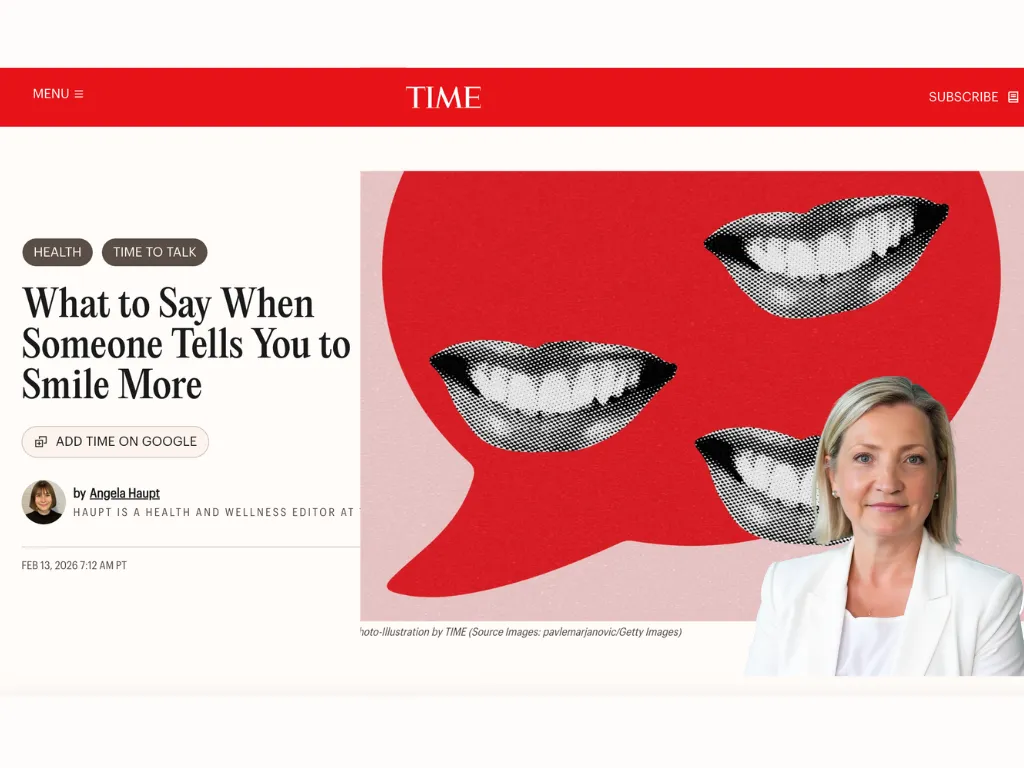
Screenshot from TIME article in which I was quoted on professional nonverbal dynamics.
Recently, I was quoted in a TIME article exploring the phrase “you should smile more.” The comment often appears casual or even well-intentioned. In professional environments, however, it rarely operates at the surface level of facial expression. It functions as a subtle nonverbal intervention.
In leadership settings, presence is constantly evaluated. Facial expression, pacing, posture, and emotional steadiness shape perception before content is fully processed. When someone tells you to smile more, they are attempting to adjust your visible signal. The key question is not whether smiling is good or bad. The key question is who is controlling the adjustment, and for what purpose.
Below is a breakdown of five common dynamics behind this remark, along with guidance for navigating them without sacrificing authority.
1. WELL-INTENTIONED BUT MISDIRECTED CARE
In familiar contexts, the remark may genuinely reflect concern. The person equates smiling with wellbeing or approachability and assumes a neutral expression signals distress.
Nonverbal indicators:
• Relaxed tone
• Open body language
• No interruption of your speaking turn
• Delivered in private rather than in front of others
In these cases, the comment is relational rather than corrective. The most effective response is acknowledgment without compliance. A simple “Thank you for checking in” preserves the relationship while maintaining autonomy over your expression. You validate intent without accepting the premise that your face requires adjustment.
2. AUTHORITY INTERRUPTION IN PROFESSIONAL SETTINGS
In meetings and evaluative environments, the phrase often operates differently. It can function as a redirection tactic. You are presenting an idea. Mid-sentence, someone comments on your expression. The focus shifts from substance to presentation.
Nonverbal indicators:
• Interruption while you are speaking
• Light or playful tone masking dismissal
• Audience awareness or side glances
• Timing that coincides with a strong point
This pattern subtly tests composure. Engaging defensively reinforces the move. Over-correcting by immediately smiling reinforces the frame that your authority depends on emotional display.
The strongest response is neutral continuation. Finish your point. Redirect to substance. If needed, say, “Let’s stay with the topic.” Authority is reinforced through steadiness, not emotional reaction.
3. PROJECTION OF PERSONAL SIGNALING STYLE
Some professionals smile frequently and unconsciously treat it as the correct default. When they say, “You should smile more, it helps people relax,” they are projecting their signaling style rather than intentionally minimizing you.
Nonverbal indicators:
• Upbeat demeanor
• Casual delivery
• Lack of strategic timing
• No shift in hierarchy during the exchange
This scenario does not require correction or education. Light acknowledgment is sufficient. “That’s an interesting perspective” or “I’ll keep that in mind” maintains smooth interaction without surrendering signal control. You neither reject nor adopt their frame.
4. DISCOMFORT REGULATION
Neutral expressions can create tension for individuals who rely on visible emotional reassurance. In serious discussions, someone may insert “Smile!” not as a correction but as an attempt to regulate their own discomfort.
Nonverbal indicators:
• Nervous laughter
• Fidgeting
• Rapid shifts in tone
• Attempts to lighten a serious moment
A clarifying question can recalibrate the exchange. “What makes you say that?” or “Is there something specific you need right now?” often reveals that the comment reflects their unease rather than your behavior. When responsibility returns to the speaker, the pressure dissipates.
5. AUTOMATIC CULTURAL CORRECTION
In some environments, especially hierarchical ones, certain professionals are expected to display warmth continuously. The remark becomes habitual rather than intentional. It reflects social conditioning more than conscious strategy.
Nonverbal indicators:
• Automatic delivery
• Repetition across contexts
• Lack of situational awareness
• Delivered to certain individuals more than others
In these cases, minimal engagement is often the most strategic choice. Silence or neutral acknowledgment prevents reinforcement of the pattern. You are not obligated to participate in unconscious correction scripts.
SIGNAL COHERENCE IN HIGH-STAKES ENVIRONMENTS
The deeper issue is not smiling. It is signal coherence. Signal coherence refers to alignment between your role, your intent, your message, and your nonverbal behavior. When those elements are aligned, authority feels stable. When they are externally adjusted, coherence fractures.
High-performing professionals often over-correct under subtle social pressure. They smile more than necessary, soften their tone excessively, or dilute their message to restore comfort in the room. Over time, this erodes perceived authority.
The strategic question in any “smile more” moment is simple: Does adjusting my expression strengthen alignment with my role, or does it reinforce someone else’s need for comfort?
Leadership presence is not emotional performance. It is composure under subtle pressure. Sometimes smiling strengthens connection. Sometimes neutrality strengthens clarity. The key is that the adjustment is intentional.
In professional environments, small moments shape perception. Perception shapes opportunity. Managing your nonverbal signal deliberately rather than reflexively is part of executive maturity.
I work with leaders and organizations to make nonverbal authority signals visible in high-stakes professional decisions.
If you want deeper insight into nonverbal intelligence and executive presence in AI-augmented evaluation environments, you can join my newsletter below or downloading my free guide on decoding nonverbal signals at tatianateppoeva.com/decode.
Media & Speaking Inquiries
For interviews, commentary, podcasts, and speaking engagements:
Email: [email protected]
LinkedIn: https://www.linkedin.com/in/tatianateppoeva