Sam Altman Walked Off the TED Stage Before the Handshake: What His Body Language Actually Reveals
Five nonverbal moments from two interviews that reveal how one of the most consequential minds in technology actually operates, and why most people have been reading him wrong.
March 11, 2026
By Tatiana Teppoeva, PhD
Nonverbal Intelligence & Executive Presence Expert
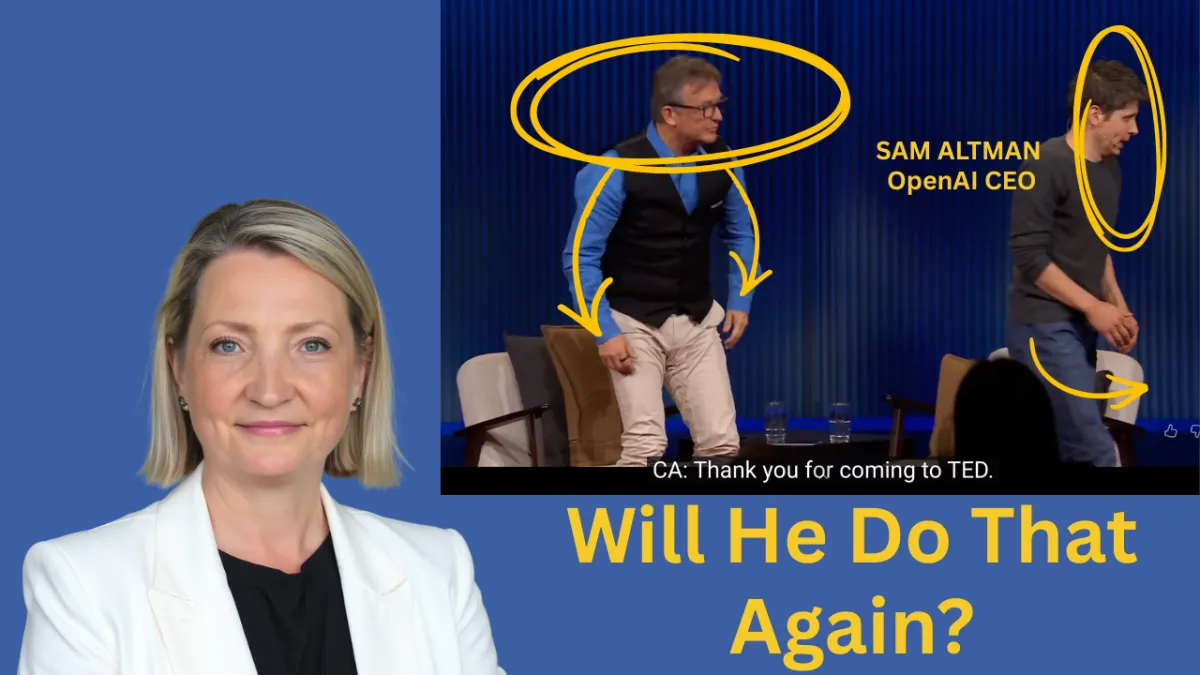
Sam Altman and Chris Anderson at TED2025.
The Moment That Made Me Stop
At the end of Sam Altman's TED2025 interview with Chris Anderson, something small happened that most viewers registered but few examined. The conversation finished. The audience applauded. Chris Anderson stood up the way hosts always do, preparing to close with a handshake and a thank you. And at that exact moment, Sam Altman turned and started walking toward the exit. Before they had even shaken hands.
Chris had to call him back.
I watched that moment and paused the video. Not because it was dramatic. Not because it was rude. Because it was specific enough to be interesting. Why would someone do that in such a controlled, high-stakes environment? And what does it tell us about how this person actually operates?
I spent years building AI predictive systems at Microsoft. I know this world from the inside. So I went back and watched the full TED interview, and then I watched his Y Combinator interview alongside it. What emerged was a detailed portrait of how a particular kind of intelligence inhabits a body, and how that shapes everything from the way he sits to the way he handles the hardest questions in the room.
Who Sam Altman Is Before We Look at the Body
To read someone's nonverbal signals accurately, we need context. Because signals mean different things depending on the person sending them.
Sam Altman is the CEO of OpenAI, the company behind ChatGPT, currently valued at over three hundred billion dollars. For many years his annual salary was around seventy-six thousand dollars. Zero equity. Before you read that as a story about sacrifice, consider the fuller picture. By the time he took the CEO role, he was already wealthy. His money came from years as one of Silicon Valley's most successful early-stage investors. Stripe, Robinhood, Reddit, Airbnb. He did not need OpenAI equity to be financially secure.
The low salary was not a sacrifice. It was a signal. It communicated: I am not here for personal gain. My incentives are clean. That distinction matters because it tells you something about how this person thinks. The financial reward was not eliminated. It was deferred, until the moment when aligning his interests with investors became strategically necessary.
For years he also treated his own biology with the same logic he applies to systems. He lifted weights three times a week. He fasted for fifteen hours each day and took only espresso in the morning. He took metformin as an anti-aging protocol and did quarterly blood testing to track his numbers. He monitored his sleep. He set himself a goal of cycling one hundred miles in a single week.
Then OpenAI entered its most critical phase. By late 2024 he was joking in interviews that he now does basically nothing, occasionally eats junk food, and does not exercise consistently anymore. The optimization system got suspended because the mission needed everything. That tells you something about his hierarchy of priorities. The body was always secondary. When the pressure became high enough, it showed.
Every single one of these behaviors follows the same internal logic. Find the system, test the inputs, measure the outputs, and optimize. This is someone who treats his own biology the way an engineer treats a machine. And when someone lives that way long enough, it begins to shape not just how they think but how they physically inhabit their body.
What His Baseline Actually Tells Us
When you watch Sam Altman speak, one thing becomes clear very quickly. His body is extremely contained. Shoulders slightly drawn inward. Arms close to his torso. Hands often resting together between his legs while he listens. Head leaning forward and slightly downward as he thinks.
You see this posture clearly in the Y Combinator interview. Then you see almost exactly the same posture on the TED stage. That repetition is important. If this posture were coming from anxiety or discomfort with the setting, it would change between the two contexts. In a friendly room with fellow founders, in an environment where he is the recognized authority, you would expect him to open up physically. But he does not. The posture remains almost identical.
This tells us something important. This is not stress behavior. This is structural behavior. This is simply how Sam Altman inhabits his body.
Think about someone who spends years deeply immersed in internal reasoning, in technical thinking, in the kind of work that happens almost entirely in the mind. Over time the body adapts to that cognitive pattern. The spine moves slightly forward, the shoulders come inward, the head drops as the brain processes. People sometimes casually call this computer neck. It is the physical record of a life spent inside a particular kind of thinking.
Compare that to a traditional corporate executive who spends most of their life managing rooms full of people. The straight spine, the wide shoulders, the posture that communicates dominance and presence before a word is spoken. Sam Altman does none of that. He often looks like the least physically dominant person in the room.
This is exactly what hundreds of YouTube comments responded to. Robotic. Empty eyes. Something is off. I don't trust him but I can't explain why. And here is where I want to be careful, because this is a mistake I see many people make, including professional body language analysts. They assume that low emotional display equals deception, or emotional emptiness, or something to be suspicious of.
There is another explanation. And I think it is more accurate.
Sam Altman often looks down before answering a question. At first glance it looks like hesitation or avoidance. But if you watch carefully, something specific is happening. He rarely begins speaking while still thinking. Instead he appears to finish the entire thought internally first, and only then looks up and delivers the answer. The audience is not watching him think on the fly. They are hearing the final version of the thought after the reasoning is already complete.
Most speakers think out loud. You can hear the search for words, the self-corrections, the improvisation. Sam Altman does the opposite. The thinking happens privately. The answer appears afterward. And once you recognize that pattern, several moments in this interview start making much more sense.
He built three hundred billion dollars in value. But he sits on a TED stage like someone who just survived an exam. The two are not contradictory. They are the same person.
The Moment Everyone Reacted To
Early in the TED interview, Chris Anderson raises the subject of intellectual property and AI training data. The audience applauds. And Sam Altman responds with a line that quickly attracted attention.
"You can clap about that all you want. Enjoy."
Almost every viewer interpreted this as arrogance. As dismissal. As a man who considers himself above the criticism. But when you slow down the video and watch his face in the moment before he speaks, the emotion looks different. It is irritation, yes. But the irritation is not directed at the question itself. It is directed at the applause.
The distinction matters. Arrogance says I am above this discussion. Impatience says this conversation just became less productive.
If you imagine someone whose primary mode is internal reasoning, audience applause is not a meaningful signal. It does not move the argument forward. For someone whose attention is focused on the argument itself rather than the social dynamic of the room, applause can feel like interference. It shifts the conversation away from the reasoning and toward the crowd reaction. And that appears to be what we are seeing here. Not contempt for the question. Frustration that the room's reaction has interrupted the actual thinking.
The Gesture Almost Nobody Noticed
Later in the same interview, Chris asks the most challenging question of the conversation. Who gave you the moral authority to make decisions that may affect the future of all of humanity?
Instead of answering directly, Sam redirects the question back toward Chris. He asks Chris what he thinks. He had already said earlier in the interview that there are things he is not going to say today. He had pre-mapped the territory before the conversation began.
But what most people missed entirely is what his hands did in the moment before he redirected. His palms came together in front of him, fingers touching, held steady. It was a brief gesture, easy to overlook. But it is one of the most revealing things in the entire interview.
Palms together in this configuration signals two things simultaneously. On the surface, it communicates measured consideration. I am being thoughtful here. I am not dismissing your question. Maximum diplomacy on the surface. But underneath that diplomatic exterior, the gesture also signals immovability. The hands are not open and receptive. They are closed and held. The position says I have already decided where I stand on this, and I am managing how I communicate that decision rather than actually reconsidering it. Maximum persistence underneath.
That combination, diplomacy on the exterior with complete internal certainty, is one of the most interesting things I observed across both interviews. And it is consistent with everything else we see from him. The thinking happens before the room sees it. The answer is already formed. The delivery is managed.
Two Very Different Faces
There are two moments in the TED interview that reveal the full range of who this person actually is, and they sit in sharp contrast to each other.
The first happens when Chris introduces a surprising element into the conversation. For a brief moment, Sam's face shows genuine tension. His eyes widen slightly, his posture tightens. For just a second it appears he did not expect what was coming. The reaction lasts perhaps two seconds. Then the composure returns.
But those two seconds tell you something important. The control you see throughout the interview is real and it is maintained, and maintaining it takes effort. When it breaks, even briefly, you see the actual nervous system underneath. The control is not effortless. It is discipline.
And then look at what happens when Chris shows Sam a photo of his child.
The strategist disappears. The controlled executive disappears. For a few seconds you see a completely different expression. A young father looking at his child. Open, unguarded, and entirely unfiltered. The warmth is immediate and unmistakable.
That contrast tells you the full range. On one side, an intense analytical intelligence that does not perform outward warmth for the room. On the other side, someone whose real self breaks through completely in a personal moment. He is not emotionally cold. He just lives almost entirely inside his own head. And when something real enters the conversation, you see the real person immediately.
TED Versus Y Combinator: Same Person, Two Contexts
The physical setup of both interviews is almost identical. Two chairs, an audience watching, casual clothes, jeans and a sweater both times. But the person inside that posture is different.
At TED his voice occasionally cracks. His body is held in, contained. He answers carefully. There is something in the way he sits that communicates obligation. He is here because the interview matters, not because he wants to be there.
At Y Combinator, the body still holds the same structural pattern, but the face is completely open. At one point the interviewer tells him he is preaching to the converted, and Sam says "this is awesome," and the response is genuine in a way that is absent at TED. He talks about what he wishes someone had told him earlier as a founder. About conviction, about resilience over a long period of time, about trusting that it is eventually going to work out. As he says this, his head goes down. He looks inward. He is genuinely accessing that memory. He compared being an entrepreneur to having a child: the good parts are better than you expected, and the hard things are shockingly much harder than anyone can express to you in advance.
That is not rehearsed. That is someone who has actually been through it.
So what is the difference between the two interviews? Not the person. The context. At Y Combinator he is the authority. He is at home, sharing from a position of trust. At TED he is being examined. And here is the diagnostic lesson worth taking from this: if you want to understand who someone really is, watch them in the room where they feel like the authority, not the room where they are being evaluated. The gap between those two versions tells you more than either version alone.
Back to the Exit
So let us return to where we started.
The conversation finishes. Chris Anderson stands up, leaning forward, preparing for the closing ritual. Sam Altman is already somewhere else. His face in that moment carries a small private expression that is not warm toward Chris. It is the face of someone whose performance has just ended and whose internal processing loop has already started running again.
Chris uses the armrest, present and engaged. Sam rises with his head down, not looking at Chris or the audience. His body has already turned toward the exit. He is not being rude. For someone whose primary processing happens internally rather than socially, closing rituals can simply lag behind the cognitive timeline. The thinking is done. The body wants to get back to work.
Chris calls him back. Sam turns. And what you see on his face is not embarrassment. It looks like the slight recalibration of someone who had already left and has been asked to return.
The man building our future walked off stage before anyone could shake his hand. Not because he is arrogant. Not because he is cold. But because for him, the performance was over. And when the performance is over, the mind wants to get back to the work.
The people building the next era of technology are not going to pause for the handshake. They are already thinking about the next problem.
Whether that feels reassuring or unsettling to you probably says something about how you already think about what is coming.
Watch the full video breakdown on YouTube.
I work with leaders and organizations to make nonverbal authority signals visible in high-stakes professional decisions.
If you want deeper insight into nonverbal intelligence and executive presence in AI-augmented evaluation environments, you can join my newsletter below or downloading my free guide on decoding nonverbal signals at tatianateppoeva.com/decode.
Media & Speaking Inquiries
For interviews, commentary, podcasts, and speaking engagements:
Email: [email protected]
LinkedIn: https://www.linkedin.com/in/tatianateppoeva