December 2025
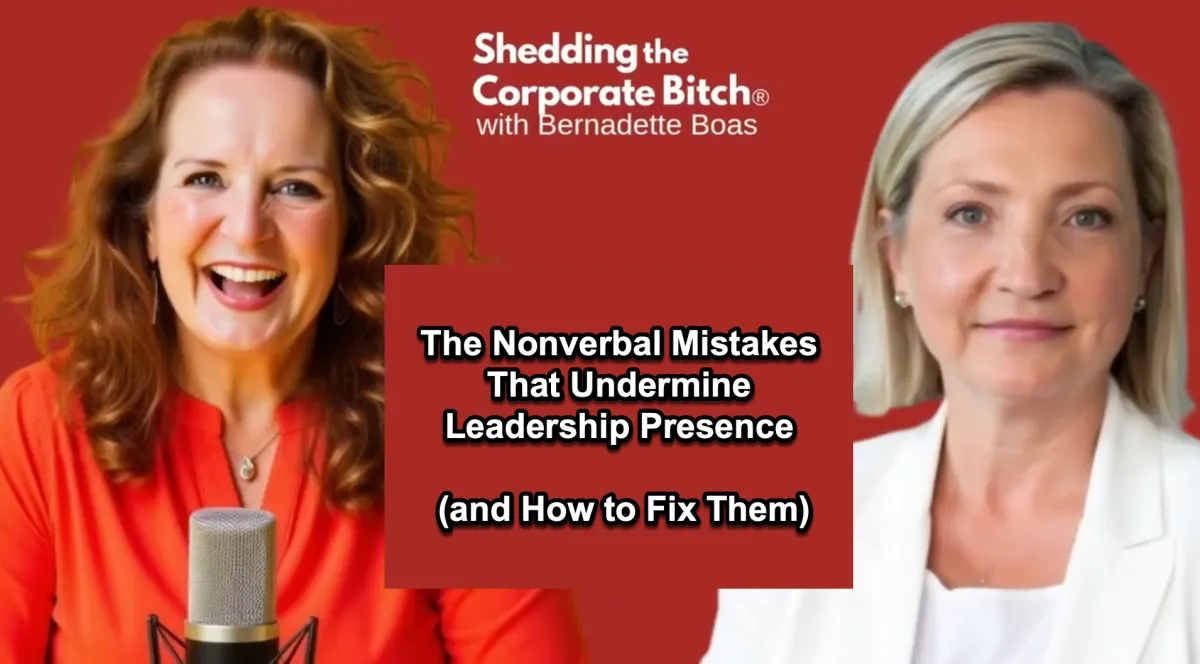
Originally Aired on Shedding the Corporate Bitch Podcast
Podcast Episode:
Nonverbal Mistakes That Undermine Leadership Credibility
How misaligned signals quietly erode authority, trust, and executive presence
In this episode of Shedding the Corporate Bitch Podcast, I explore how nonverbal behaviors shape leadership credibility long before results or expertise are evaluated. The conversation focuses on how mixed signals, tension, and unconscious habits erode authority, especially in high-stakes, visible leadership roles.
I discuss why leaders often believe they are projecting confidence while their nonverbal signals tell a different story. We examine how aggression, incongruence, and self-minimizing behaviors quietly weaken trust, even when intentions are positive and messaging is strong.
The episode also looks at the role of context and consistency, why isolated behaviors should not be over-interpreted, and how patterns over time determine how leaders are perceived. I explain why nonverbal alignment matters more than technique, and why presence is not something to perform but something others experience.
Throughout the discussion, I return to a central idea: credibility is not built by trying harder, but by reducing signal leakage. When nonverbal behavior aligns with intent, leadership authority stabilizes and trust rises naturally.
Click below to play the episode.
Core Insights from the Episode
When words and signals conflict, the brain trusts the signal.
Insight
When verbal and nonverbal messages contradict each other, people do not average them. The nervous system resolves the conflict by trusting what it can physically sense. This happens automatically and outside conscious reasoning, which is why trust breaks even when language sounds correct.
Quote
“When verbal and nonverbal don’t match, people believe nonverbal.”
Executive presence cannot be copied. It has to fit the person.
Insight
Borrowing confident gestures from other leaders often backfires. When movements, posture, or tone do not match someone’s personality or nervous system, the result looks artificial rather than authoritative.
Quote
“What elevates one person’s presence may look artificial on someone else.”
Trust erodes faster through misalignment than through mistakes.
Insight
People are willing to forgive errors. What damages credibility is when a leader’s words and actions repeatedly contradict each other. Over time, people stop listening and start watching instead.
Quote
“If a manager says one thing but does another, this doesn’t land.”
Most people cannot see their own nonverbal blind spots.
Insight
The brain is wired to protect emotional safety. As a result, people often fail to notice their own filler words, posture shifts, or tension patterns unless someone else points them out.
Quote
“Our brain likes safety, so oftentimes we don’t notice things that we are doing.”
In emotional or high-stakes moments, nonverbal signals dominate.
Insight
When conversations involve conflict, fear, or intimacy, nonverbal communication carries most of the message. Words lose influence when emotional signals point in a different direction.
Quote
“In some communications when it’s about emotions… nonverbal actually represents up to 93% of the overall communication.”
Authority is often weakened by trying to be too agreeable.
Insight
Many experienced professionals, especially women, soften their voice, shrink their posture, or phrase statements as questions in order to appear likable. These adjustments unintentionally reduce perceived authority.
Quote
“When we try to make ourselves smaller… it undermines our messaging and we feel smaller, we look smaller, and people perceive us smaller.”
Context matters more than any single gesture.
Insight
A crossed arm, head shake, or where someone sits at a table has no fixed meaning. Nonverbal signals only make sense when viewed as patterns over time and within situational context.
Quote
“It’s super important to know the context.”
Self-recording reveals what the brain hides.
Insight
One of the fastest ways to improve nonverbal awareness is to record yourself and watch without sound. This exposes posture, tension, and gestures that most people miss when they only listen to their words.
Quote
“Record yourself. Watch without sound first.”
Presence is not performance. It is alignment.
Insight
Executive presence does not come from acting confident. It comes from aligning posture, voice, and movement with internal state so that authority feels stable rather than forced.
Quote
“Presence is no longer about performance. It’s about precision.”
Originally Aired on Shedding the Corporate Bitch Podcast
I work with leaders and organizations to make nonverbal authority signals visible in high-stakes professional decisions.
If you want deeper insight into nonverbal intelligence and executive presence in AI-augmented evaluation environments, you can join my newsletter below or downloading my free guide on decoding nonverbal signals at tatianateppoeva.com/decode.
Media & Speaking Inquiries
For interviews, commentary, podcasts, and speaking engagements:
Email: [email protected]
LinkedIn: https://www.linkedin.com/in/tatianateppoeva