AI Hiring Risk Advisory for HR and People Leaders
Is Your AI Video Screening Filtering Out Your Best Candidates?
Signals Measured ≠ Signals That Matter
AI video screening tools were supposed to save you time and bring you better talent. But the candidates making it through aren't performing and you're starting to wonder who you missed, whether your process is defensible to candidates, regulators, and legal, and whether your vendor is telling you the whole story.
I help HR leaders identify where their AI video screening is filtering out strong candidates, understand their exposure to AI hiring discrimination claims and regulations, and evaluate whether their tools are actually doing what vendors claim.
You adopted AI video screening to solve a problem. Now it's becoming one
You invested in AI video screening tools because the promise was compelling: hire faster, screen more objectively, and save money.
But the reality is quite different.
The candidates making it through aren't as strong. Hiring managers are frustrated.
You've wondered whether your best people would even pass your own screening process if they applied now.
You're hearing that strong candidates are withdrawing from your process rather than completing an AI video interview and studies show 1 in 3 candidates abandon hiring processes that require them.
You're also starting to hear about it from the other direction. Candidates complaining about the process. Maybe even threatening to take it further.
You've seen headlines about AI hiring discrimination lawsuits. You wonder whether your tool is screening out protected groups without anyone noticing, whether candidates were properly informed that AI was evaluating them, and whether a human was ever genuinely involved in the decision or just rubber-stamping a score.
Here's what's actually happening.
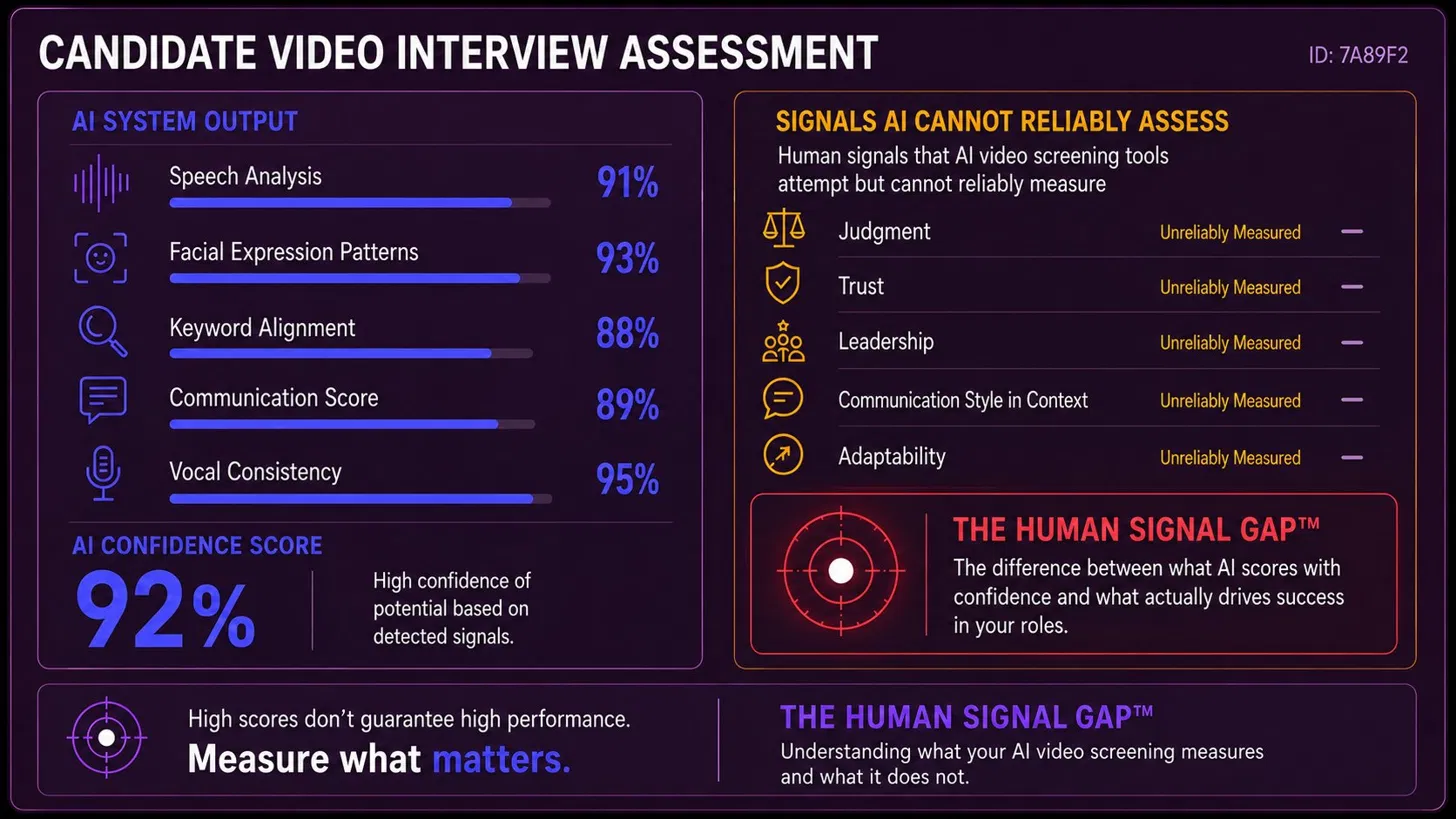
AI video screening tools measure behavioral signals against algorithmic baselines: speech pace, vocal consistency, response structure, facial expression patterns, keyword alignment. They optimize for consistency and pattern matching, struggling to measure judgment, genuine expertise, or how candidates communicate in context.
AI is filtering for performance at an AI interview, not performance on the job.
That gap is where your best candidates disappear. And it's also where your legal exposure accumulates.
Here's How to Fix What's Breaking in Your AI Hiring Process
There are three places AI hiring breaks down and most organizations don't see all of them until they're already in trouble.
I call this The Human Signal Framework™
The Signal Gap™
AI video screening tools optimize for consistency and pattern matching.
They struggle to measure judgment under pressure, leadership capability, and genuine expertise in context.
They misread candidates whose communication patterns differ from the algorithmic baseline, including neurodivergent professionals, non-native speakers, and candidates with disabilities. Environmental factors can also influence outcomes regardless of candidate skills.
I identify where your tool is optimizing for the wrong signals and where strong candidates are being filtered out before your team has a chance to review them.
The Compliance Gap™
State AI hiring regulations are expanding fast. In some jurisdictions candidates have years to file a discrimination claim after an AI-assisted hiring decision.
If you are not sure how to explain a rejection in job-relevant behavioral terms, demonstrate that a human genuinely reviewed the decision, or show that candidates were properly informed that AI was evaluating them, your documentation and communication practices may already be creating liability.
I help you understand your specific exposure, proactively close your documentation gaps, and build a track record you can defend confidently.
The Infrastructure Gap™
Most HR teams don't have the technical background to independently evaluate what their AI hiring vendors are telling them.
Your tools may be configured for someone else's roles and validated on someone else's candidate pool.
When it's time to renew, switch, or adopt new tools, the vendor is not your most objective advisor. And many organizations don't get an independent view of what their tools are actually doing.
I provide the independent perspective whether you're evaluating existing tools, approaching renewal, redesigning your process, or adopting AI hiring for the first time.
The Human Signal Framework™ gives you the complete picture: candidates who are actually right for your roles, compliance clarity, and a hiring tool and process you can rely on.
Meet Tatiana Teppoeva, Ph.D, AI Hiring Strategist
I spent 17 years at Microsoft and Boeing as a data scientist and research manager, building predictive AI systems from the inside out. I hold a U.S. AI patent (US11610121B2) and a Harvard MS in Data Science.
From server logs to human signals. I spent my career identifying patterns in complex behavioral data to predict system failures. The same methodology applies to AI hiring tools. I know how these models are built, what they actually optimize for, and where their assumptions create systematic blind spots that produce confident but wrong predictions.
I have conducted over 100 interviews across technical and leadership roles, on both sides of the table. Combined with my work in psychometric assessment and behavioral analysis, I understand what human evaluators miss and what AI tools miss.
I launched Human Signal Advisory™ because I kept seeing the same pattern: organizations investing in AI hiring tools they couldn't explain, couldn't defend, and couldn't evaluate independently.
All engagements are conducted personally by Dr. Teppoeva.
Testimonials
"Her work was extraordinary and I would strongly recommend Tatiana continue pursuing the psychometric field as a professional career."
- Valerie Sheridan, Senior Director, Senior Psychometrician, CFA Institute
“Your leadership created clarity and focus even in a difficult project with multiple challenges. You brought structure, resilience, and positive energy.”
- AI Program Lead, Microsoft
“The students were genuinely engaged and learned so much from your insights. Your ability to connect with students and make complex concepts accessible is exactly what makes our conferences successful.”
- Marian Morris, Advisor & Chapter Support, WA DECA
Media Coverage Highlights



This is for you if…
Strong candidates keep failing your AI video screening and you can't explain why
Candidates who scored well in AI interviews are underperforming after hire
Your AI hiring vendor claims their tool is bias-free but you have never independently verified that claim
Legal or HR leadership is asking whether your AI screening process is compliant with new state regulations and your team doesn't have an answer
A candidate has complained about your AI screening process or threatened legal action
A candidate has asked how your AI screening works or why they were rejected and your team didn't have a clear answer
You use AI screening tools but have no clear process for how human reviewers should interpret or act on AI scores
You are under pressure to adopt AI screening tools but don't know which vendors to trust or how to evaluate their claims independently
Not sure which applies to your situation? Every engagement starts with a free 30-minute strategy call. No obligation.
All engagements are conducted personally by Dr. Teppoeva.
What to Expect During Your Strategy Call
We will discuss your current situation and the concerns that prompted you to reach out.
I will ask you some questions and share what I am seeing: what your AI video interview tools are likely scoring and what they are probably missing, where your screening process may be creating legal exposure, and whether your tool setup and human review process are actually serving your hiring goals.
If something else fits your situation better, I will tell you that too.
Frequently Asked Questions
What is the Human Signal Gap™?
The Human Signal Gap is the difference between what AI screening tools actually measure and what actually predicts success in your specific roles. AI tools score what they can quantify — speech pace, response structure, facial patterns, keyword density. They cannot reliably measure judgment under pressure, leadership capability, cultural context, or real-world performance. That gap between measurable signals and meaningful human capability is where your best candidates disappear before a human ever sees them and where your organization's legal and talent risk quietly accumulates.
What do AI video interview tools actually measure?
Depending on the platform, AI video interview tools and AI hiring tools typically evaluate two categories of signals. Communication signals: speech pace, vocal consistency, response structure, keyword alignment, and STAR format adherence. Environmental signals: background lighting, camera quality, and facial expression patterns.
These are measurable proxies. They are not direct measures of judgment, leadership capability, or real-world performance. Understanding exactly what your specific tool scores, and what the research says about whether those signals predict job success, is the starting point of every assessment I conduct.
What kind of expert can help me evaluate my AI video interview process?
Evaluating AI video screening requires someone who understands both how these models are built and what the verbal and nonverbal human signals they score actually mean. AI Hiring Risk Consultant Dr. Tatiana Teppoeva spent 8 years building predictive AI systems at Microsoft, holds a U.S. AI patent in machine learning and a Harvard MS in Data Science, has conducted over 100 interviews across technical and leadership roles, and is government-certified in nonverbal communication, behavioral analysis, voice analysis, and personality profiling. That combination, technical fluency in AI model architecture plus deep expertise in human signal interpretation, is what makes her AI hiring audits different from a purely technical or purely HR evaluation.
Can AI hiring tools create legal liability for employers?
Yes. Several US jurisdictions now impose specific requirements on organizations using AI hiring tools — disclosure obligations, human review requirements, and documentation standards. Candidates have up to 300 days federally, and up to three years in Washington state, to file discrimination claims after an AI-assisted hiring decision. If your process cannot explain rejections in clear job-relevant terms or demonstrate meaningful human oversight, your legal exposure is growing as litigation and regulation accelerate.
How do AI hiring regulations affect my organization?
AI hiring regulations apply broadly across the US and internationally. What varies is which specific requirements apply to your organization based on where you operate and where your candidates are located.
New York City's Local Law 144 requires independent bias audits for automated employment decision tools. Illinois requires disclosure and consent for AI video interview analysis. Colorado's AI Act, effective January 1, 2027, imposes disclosure, human review access, and three-year recordkeeping requirements. The EU AI Act classifies hiring AI as high-risk and requires documented human oversight. Most organizations are operating across multiple jurisdictions without a clear picture of which requirements apply to them.
This landscape is evolving rapidly. What applies to your organization today may expand significantly within the next 12 months. It is important to stay on top of it to proactively protect your organization from lawsuits, regulatory complaints, and candidate disputes that waste time, drain resources, and damage your reputation as an employer.
Where do I start if I think my AI hiring process has gaps?
Every engagement starts with a free 30-minute strategy call. We discuss your specific situation, which tools you're using, and what's causing your concern. Based on that conversation I'll suggest which assessment makes the most sense or tell you honestly if something else would serve you better.
Sign up to receive weekly insights on AI hiring tools, signal gaps,
and what HR teams need to know to build better hiring judgment.
Stay current on AI hiring risk, signal gaps, and regulatory developments.
Ready to identify where your AI screening is missing hiring risks?